Estonian knitting patterns and their stories: the Muhu star, rib, cable and bubble knit
A pattern is more than decoration on a knit. It decides how thick, warm and stretchy the knit is, and it carries a story that can be hundreds of years old. ME knit pieces carry on patterns that have been worn for generations in Estonia and around the Baltic Sea, plus one pattern that is our very own. Here are their stories.

How the sweater came to the Estonian islands
For a long time, Estonians knitted mainly stockings, gloves and mittens. Knitted sweaters only appeared here in the last decades of the 19th century, inspired by Scandinavia, where sweater knitting had flourished with the arrival of industrial yarn dyes. Ethnologist Riina Tomberg writes that it was on Saaremaa, Muhu, Kihnu and Ruhnu that sweaters gained a distinctive local character and striking designs.
On Muhu, clothes were kept as treasured heirlooms and passed down from one generation to the next. A Muhu woman was judged by how skilled a knitter she was, and bright, richly decorated sweaters were made for men to wear at their weddings, for example. Within fixed rules, every knitter tried to give her sweater a personal touch.

The Muhu pattern and the eight-pointed star
The kaheksakand, or "Muhu mänd", is an eight-pointed star that also appears on the coat of arms of Muhu parish. On Muhu it is seen as the island's own symbol, but film director Mark Soosaar has written in the Estonian daily Postimees that the star was probably not invented on Muhu, but skilfully woven into island culture. The same star appears on rugs from Gotland, India and Peru, and in Latvia it is known as Auseklis, the morning star.
In knitting, too, the star is old. As early as the 16th century, silk knits from England with a relief pattern of large eight-pointed stars were shipped to Denmark, Norway and Sweden, and later stars decorated Danish and Swedish sweaters and the white Sunday sweater of the farm wives of Ruhnu. Our Muhu pattern scarf is inspired by the eight-pointed stars of Muhu folk patterns: the two-colour design makes a simple winter scarf stand out.
Rib: simple, stretchy and timeless
Rib is a knit in which knit and purl stitches alternate in vertical columns. The columns pull the fabric together and make it very stretchy, which is why every sweater has ribbing at the cuffs, hem and neckline. Rib adapts to different shapes and stays in place.
The Soonik beanie has a double turn-up cuff, so there are two layers of wool over the ears. The Soonik scarf, Soonik wrist warmers and Soonik headband come in the same knit. A simple pattern that suits women and men alike and never goes out of style.

Cable: the sweater classic
In a cable pattern, stitches are crossed over each other to form raised ropes that look like plaits. The relief surface makes the knit thicker and warmer. The most famous cable sweaters come from the Aran Islands off the west coast of Ireland. Historians have shown that the Aran sweater only became known in the 20th century, and that the story of every family having its own pattern so drowned fishermen could be identified is a later myth.
Our Palmik beanie with its wide turn-up cuff and the Palmik wrist warmers bring this classic into an everyday winter wardrobe.

Fisherman's rib: thick and fluffy
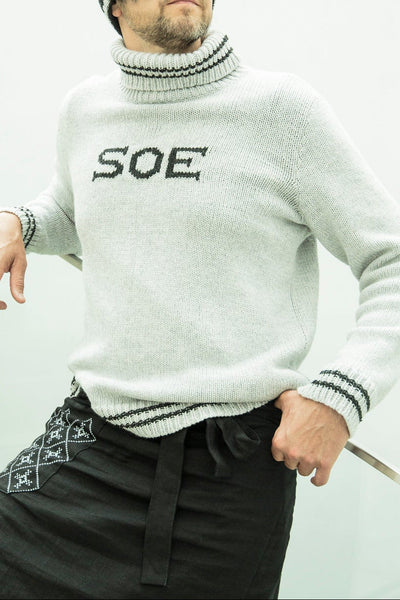
Fisherman's rib looks like ordinary rib but is much thicker and fluffier, because half of its stitches hold a double strand of yarn. It has a long history on the Estonian islands too: according to Tomberg, the sweaters of Hiiumaa were made in dense fisherman's rib, and on Ruhnu both men and women wore a grey fisherman's rib sweater every day, even in summer. In cold weather they wore two, one on top of the other.
Our Frode jumper is from the SOE collection: a jumper with a high buttoned collar in fluffy fisherman's rib that keeps you warm on a cold winter's day and suits both men and women.

Tuck stitch: lacy and light
In tuck stitch, some stitches are left unknitted for a few rows and gather into the next stitch. This creates a delicate, lace-like pattern on the surface of the knit that is light but still warm. The Tuck shawl, Tuck neck warmer, Tuck headband and Tuck wrist warmers are our most delicate pieces.

Mummu bubble knit: ME knit's signature pattern
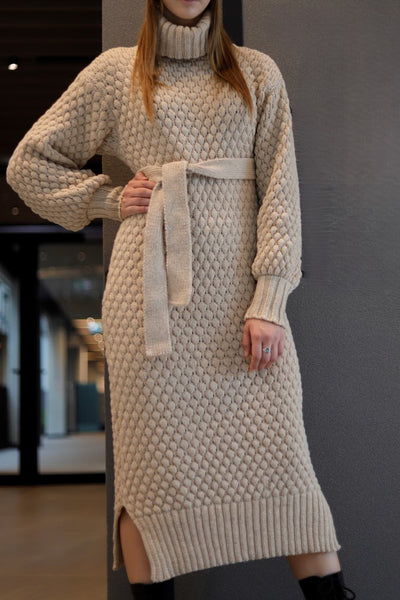
Mummu is ME knit's own pattern. The name comes from the Estonian word "mumm", a round dot: the surface of the knit is covered in small, fluffy bubbles that make it playful and thicker. The fluffy surface traps air and with it warmth, and the knit is stretchy and comfortable.
The Mummu beanie, Mummu scarf, Mummu wrist warmers, Mummu mittens and Mummu jumper are all in bubble knit, along with several dresses. A hat, scarf and wrist warmers in the same knit make a matching set.
Old patterns, modern shapes
ME knit pieces are designed by Irja Lembra, a fashion design graduate of the Estonian Academy of Arts who has shown her collections at Estonian Fashion Festival. They are made in Estonia by the knitwear maker Top Kudum, which has more than 28 years of experience. In our knitwear, old patterns get a new life: simple shapes, soft merino wool from Italy and colours that fit a modern wardrobe. Read more in our story.
Sources and further reading
Tomberg R. Vatid, troid, vamsad. Silmkoekampsunid Lääne-Eesti saartel (Knitted sweaters on the West Estonian islands, in Estonian). Mäetagused, 2005; 29.
Soosaar M. Mõjusad Muhu mustrid (Striking Muhu patterns, in Estonian). Postimees, 10 January 2004.
Wikipedia (Estonian). Muhu valla vapp (coat of arms of Muhu parish).
Carden S. Cable Crossings: The Aran Jumper as Myth and Merchandise. Costume, 2014; 48(2): 260–275.
Institute of the Estonian Language, Sõnaveeb: mumm.
Further reading: Pink A., Reimann S., Jõeste K. Estonian Knitting 1: Traditions and Techniques. Saara Publishing.